
CAD & 3D Prototyping For Pressure Regulator & Valve
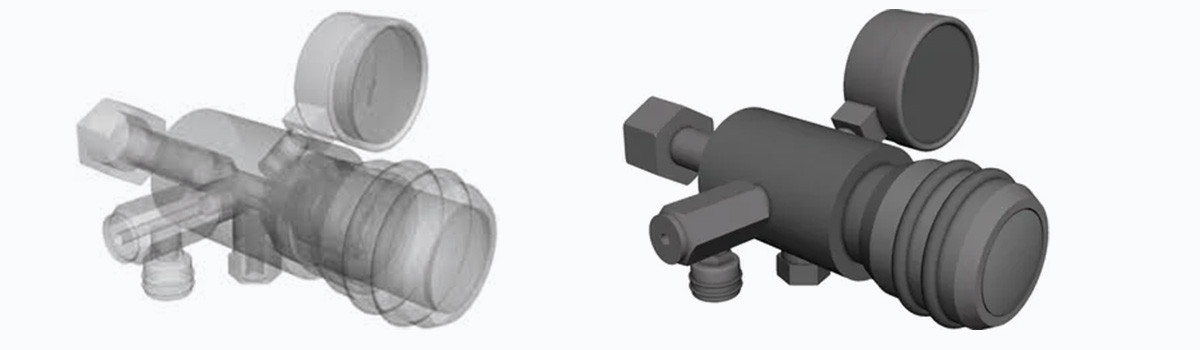
Prototyping with 3D Printing
Prototyping is an extremely important step in product development. Prototyping custom manufactured parts, in particular, provides the opportunity to evaluate your design, demonstrate its concept, inspect it for flaws, correct any issues, and improve overall design. However, traditional prototyping can be a very time-consuming and expensive process.
Valve manufacturers today have increasingly adopted techniques for 3D design and are exploring the possibility of Metal 3D printing. Originally developed in the 1980s, 3D printing (also known as additive manufacturing) has evolved dramatically over the past 30 years, enabling companies to fully customize and create more accurate prototypes and products than ever before.
Besides saving costs and time, additive manufacturing allows the same CAD software to be used to create various geometries, making it an extremely versatile process. And unlike CNC machining, 3D printing produces minimal waste, as the process only prints the material actually needed to create the desired product.
Steps of 3D Valve Design
The first step of designing any valve is assessing need. A request is made to create a new valve, with specific requirements as indicated by the purchaser. The valve manufacturer adheres to the specifics of the order, determines the best course of action, and the process(es) needed to fulfill it. In this stage, a 3D CAD drawing of the valve is created. The drawing, or design file is then uploaded to the related software program via computer.
The next step is Finite Element Analysis (FEA), which uses mathematical models to quantify real world effects on the valve. The simulations are conducted using specialized software that helps determine the source of potential problems, such as area of fault, weakness, or tension.
Understanding Pressure Regulators and Valves
The Role of CAD in Designing Pressure Regulators and Valves
- Precision and Customization: CAD enables the creation of highly detailed models with precise measurements, ensuring that every component of a pressure regulator or valve—such as seals, diaphragms, or valve seats—meets exact specifications. This is critical for applications requiring tight tolerances, such as aerospace or medical devices. CAD also supports customization, allowing engineers to tailor designs to specific applications, such as high-pressure gas regulators for industrial use or low-pressure valves for medical oxygen delivery.
- Simulation and Analysis: Modern CAD software includes simulation tools like Finite Element Analysis (FEA) and Computational Fluid Dynamics (CFD). These tools allow engineers to test how a pressure regulator or valve will perform under various conditions, such as high pressure, temperature extremes, or corrosive fluids. For example, CFD can simulate fluid flow through a valve to optimize its design for minimal turbulence or pressure drop, while FEA can predict how a regulator’s components will withstand mechanical stress.
- Collaboration and Iteration: CAD facilitates collaboration among multidisciplinary teams by allowing designs to be shared, reviewed, and modified in real time. Cloud-based CAD platforms, such as Onshape, enable global teams to work simultaneously on a project, reducing design cycles. Engineers can quickly iterate designs based on feedback or simulation results, ensuring the final product meets performance and regulatory requirements.
“The 3D soft-ware system is similar to creating a virtual environment. You plug in the perimeters of the valve, including materials, wall thicknesses and so forth, then conducts real life analysis and strength to verify it meets all given requirements,” said the valve expert. Following analysis, building begins as the 3D printer creates the product or part layer by layer over a series of hours. The time frame to print is determined based on size, specifications, and the like. Once printing is completed, the printed piece is removed and inspected. Further inspections can include dimensional inspections, various non-destructive examinations, performance testing and/or pressure testing depending on the component.

The benefits of 3D designing valves are obvious; increasing production efficiencies, and reducing overall wait time for customers to make, create, and receive their valves is very important to the market. The less time spent waiting for parts, the more up time the process or application will endure. Less time wasted directly translates to profit increase for companies, as valves are often critical components in industry. For example, a refinery in need of an isolation valve on a storage tank responsible for maintaining the separation of different oil products is imperative to avoid the cross contamination of fuels and maintain high quality product. This rapid improvement of prototypes, and the ease of access for customers, are huge benefits of the 3D valve design.
Elimination of material waste is another added benefit of 3D design. With computer-aided design, printing is precise and done layer by layer. This process further permits the manufacturing of unique and highly specified components. While 3D metal printing is currently applicable on smaller valve parts, traditional manufacturing methods are often wasteful and consume large amounts of raw materials and energy. Instead of foundering and machining a valve component from a large piece of material, 3D printing, in comparison, can create the component with considerably less waste. As much of the design is created on the computer, improvements are easier to implement, and simulations are made easier.
In some cases, 3D design imagery helps customers identify what they are requesting. If there is any type of customization, it also gives them a chance to review and improve upon it prior to its manufacture. That eliminates any guesswork for EPCs and engineering companies working on, for example, complex piping systems. 3D design is more detailed and flexible, as opposed to classic blue line drawings.
Those who build chemical plants and refineries utilize many different piping systems, running in several directions. With 3D design, engineers can walk through and inspect each valve and related piping component as if it was a virtual 3D environment. This often translates to earlier design approvals. 3D design can also streamline the manufacturing process, leading to greater efficiency gains.
3D technology ultimately increases speed and design flexibility, and reduces the risk and the amount of waste within additive manufacturing. No material limitations, alongside complete customization, higher yields, and lower costs are all extremely advantageous to 3D design and printing. This technology also offers huge benefit to those looking to create a prototype quickly and accurately.
As valve manufacturers continue to optimize 3D valve design and printing processes, end users will be offered more options than ever before. Real economic benefit will arrive as 3D printing becomes intrinsic to all facets of the manufacturing industry. In theory, the only limitation with 3D design is your imagination, and manufacturers like ISV are well equipped to manage the requests of existing, and future valve users.
3D Printing for Valve Prototypes
Prototyping is notoriously challenging in the valve industry; valves are incredibly complex multi-component parts that require a full set of custom tooling to prototype. Tooling is a huge driver of time and costs for valve prototyping, especially for check valve prototyping. Luckily, 3D printing is making as big an impact in valve manufacturing as it is in car manufacturing.
A 3D printer that can use for valve prototyping, and its impact has been tremendous. This printer provides us with functioning 3D models to present to clients, which has proven to be a huge boon for collecting quality feedback from customers.
Compatible with all existing CAD software, it allows our designers and engineers to incorporate that feedback almost immediately and carry those ideas forward as the project progresses. Perhaps most importantly, it allows us to prototype valves for customers at drastically lower price points than we were capable of previously.
The Power of 3D Prototyping
Once a CAD model is complete, 3D prototyping—often through additive manufacturing (3D printing)—brings the design into the physical world. Technologies like Stereolithography (SLA), Selective Laser Sintering (SLS), and Fused Deposition Modeling (FDM) allow engineers to create functional prototypes of pressure regulators and valves quickly and cost-effectively.
- Rapid Prototyping: 3D printing enables the production of prototypes in hours or days, compared to weeks or months for traditional methods like CNC machining or injection molding. This speed is critical for industries where time-to-market is a competitive advantage. For instance, a medical device company developing a new oxygen regulator can use 3D printing to create multiple iterations of a valve design, test them, and refine the model within days.
- Material Versatility: Modern 3D printers can work with a wide range of materials, including plastics, metals, and composites, which are suitable for prototyping pressure regulators and valves. For example, stainless steel or titanium 3D printing can produce durable prototypes for high-pressure applications, while flexible resins can simulate rubber seals or diaphragms. This versatility allows engineers to test prototypes under conditions closely resembling real-world use.
- Cost Efficiency: Traditional prototyping methods require expensive tooling and molds, which are impractical for small-batch or one-off designs. 3D printing eliminates the need for custom tooling, reducing costs significantly. Engineers can produce multiple prototype iterations without breaking the budget, making it easier to optimize designs for performance and manufacturability.
- Functional Testing: 3D-printed prototypes can be used for functional testing, such as checking the fit of components, evaluating flow characteristics, or assessing durability under pressure. For example, a 3D-printed valve prototype can be tested in a controlled environment to ensure it opens and closes correctly or maintains a seal under high pressure. This reduces the risk of costly errors in the final production phase.
The Workflow: From CAD to 3D Prototype
The integration of CAD and 3D prototyping follows a streamlined workflow:
- Conceptual Design: Engineers use CAD software to create a digital model of the pressure regulator or valve, incorporating specifications such as dimensions, materials, and performance requirements.
- Simulation and Optimization: The CAD model undergoes simulations (e.g., FEA or CFD) to evaluate its performance. Engineers refine the design based on simulation results, optimizing for factors like flow efficiency, structural integrity, or weight reduction.
- Prototyping: The finalized CAD model is exported to a 3D printer, which produces a physical prototype. Depending on the application, the prototype may be printed in plastic for initial testing or in metal for more rigorous evaluation.
- Testing and Validation: The prototype is tested for functionality, durability, and compliance with industry standards (e.g., ASME, ISO, or API). Feedback from testing informs further design iterations in CAD.
- Production: Once the prototype is validated, the design can be sent to manufacturing, often using advanced techniques like CNC machining or additive manufacturing for final production.
Benefits of CAD and 3D Prototyping
The combination of CAD and 3D prototyping offers numerous benefits for pressure regulator and valve development:
- Speed: Rapid design and prototyping reduce development timelines, enabling faster product launches.
- Cost Savings: Eliminating physical tooling and minimizing material waste lower development costs.
- Innovation: Engineers can explore complex geometries and innovative designs that would be difficult or impossible with traditional manufacturing.
- Accuracy: Digital models and precise 3D printing ensure components meet exact specifications.
- Sustainability: Additive manufacturing reduces material waste compared to subtractive methods like machining.
Challenges and Considerations
While CAD and 3D prototyping are transformative, they come with challenges. High-end CAD software and 3D printers can be expensive, requiring significant upfront investment. Additionally, 3D-printed prototypes may not always match the material properties of final production parts, requiring careful selection of printing materials. Engineers must also ensure that designs comply with industry standards and regulations, which may necessitate additional testing and certification.
The Future of CAD and 3D Prototyping
The future of CAD and 3D prototyping for pressure regulators and valves is bright, with emerging technologies poised to further enhance their capabilities. Artificial intelligence (AI) and machine learning are being integrated into CAD software to automate design optimization and predict performance issues. Advanced materials, such as high-strength polymers and metal alloys, are expanding the possibilities for 3D-printed components. Additionally, hybrid manufacturing systems that combine additive and subtractive processes are enabling the production of fully functional parts directly from CAD models.
In the coming years, we can expect greater adoption of digital twins—virtual replicas of physical components—that allow real-time monitoring and optimization of pressure regulators and valves throughout their lifecycle. These advancements will further reduce costs, improve performance, and accelerate innovation in industries reliant on these critical components.
Conclusion
CAD and 3D prototyping have transformed the design and development of pressure regulators and valves, offering unmatched precision, speed, and flexibility. By enabling engineers to create, simulate, and test complex components in a virtual and physical environment, these technologies are driving innovation and efficiency across industries. As advancements in AI, materials, and manufacturing continue to evolve, the potential for CAD and 3D prototyping to revolutionize pressure regulator and valve development will only grow, paving the way for smarter, more reliable, and sustainable solutions.