
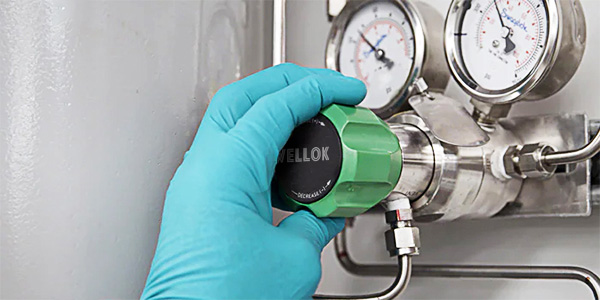
High Purity Gas Regulator
Core Function: Precision Pressure Control + Zero Contamination
Precision Pressure Control: The Primary Mission
- Changing inlet pressure: As a gas cylinder depletes, the pressure inside drops—sometimes dramatically from 3,000 psig to under 500 psig. A robust regulator compensates seamlessly, preventing downstream fluctuations.
- Varying downstream flow demand: Processes rarely run at steady state. Flow can surge from near-zero to 100 standard liters per minute (slpm) or more in an instant. The regulator must respond without lag or overshoot.
- Temperature fluctuations: Ambient or process heat can alter gas density and pressure. A well-designed regulator remains unfazed across wide temperature swings.
How It Works: The Diaphragm-Poppet Dance
Inlet gas pressure × Poppet area = Spring force + Outlet pressure × Diaphragm area- Sensing: A thin, flexible diaphragm continuously monitors outlet pressure.
- Response:
- If outlet pressure drops (due to increased demand), a calibrated spring pushes the poppet open, allowing more gas to flow.
- If outlet pressure rises (due to reduced demand or inlet surge), the gas force on the diaphragm overcomes the spring, closing the poppet.
- Equilibrium: This feedback loop operates in milliseconds, maintaining set-point pressure with extraordinary fidelity.
Zero Contamination: The High-Purity Imperative
- Particulates
- Moisture
- Hydrocarbons
- Metallic ions
- Outgassing byproducts
- 316L VIM/VAR stainless steel or electropolished surfaces reduce particle shedding and adsorption sites.
- Metal diaphragms (not elastomers) eliminate organic outgassing and permeation.
- Tied diaphragm designs prevent gas from contacting secondary seals or lubricants.
- Helium leak-tested assemblies (to 1×10⁻⁹ atm·cc/sec) ensure no external ingress.
Why This Matters: Real-World Impact
Engineering Excellence in Miniature
- Ultra-low hysteresis springs
- Precision-machined orifices
- Large sensing areas for sensitivity
- Damped poppet motion to prevent chatter
High Purity vs. General-Purpose Regulators: 12 Critical Differences
Feature | General-Purpose Regulator | High Purity Regulator |
|---|---|---|
Body Material | Brass, aluminum | 316L SS, VIM-VAR, Hastelloy |
Internal Finish | 15–25 µin Ra | 3–7 µin Ra electropolished |
Diaphragm | Neoprene, Buna-N | 316L SS, Hastelloy, Inconel |
Seat | Nylon, PTFE | PCTFE, Vespel, metal-to-metal |
Helium Leak Rate | 1×10⁻⁶ atm-cc/sec | 1×10⁻⁹ or tighter |
Outgassing | ppm levels | < 10 ppt hydrocarbons |
Particle Generation | 0.1–1 µm | < 0.01 particles > 0.02 µm |
Moisture Contribution | 1–10 ppm | < 1 ppb |
Purity Grade Supported | 4.5 (99.995 %) | 6.0–7.0 (99.9999–99.99999 %) |
Cost | $50–$300 | $800–$4,500 |
MTBF | 1–3 years | 5–15 years |
Certifications | CGA, ISO 2503 | SEMI F1, ASME BPE, ASTM F1397 |
Materials Science: Building a Contaminant-Free Flow Path
Base Metals
- 16L Stainless Steel (Low Carbon): ≤ 0.03 % C prevents carbide sensitization during welding.
- 316L VIM-VAR: Vacuum Induction Melt + Vacuum Arc Remelt reduces inclusions to < 1 ppm.
- Hastelloy C-22: Ni-Cr-Mo alloy for Cl₂, HCl, HF.
- Monel 400/K-500: For NH₃, marine environments.
- Inconel 718: Cryogenic service to –196 °C.
Surface Finishing
- Electropolishing: Removes 20–30 µm of surface metal, leaving 3–5 µin Ra and a 30–50 Å Cr₂O₃ passive layer.
- Passivation: Citric or nitric acid forms oxide barrier; verified by < 1 ppb Fe in rinse water (ASTM A967).
Diaphragm Technologies
Material | Permeation Rate | Temperature | Cycle Life |
|---|---|---|---|
316L SS | Zero | –40 to 150 °C | 500,000+ |
Hastelloy | Zero | –70 to 200 °C | 400,000 |
Viton | 10⁻⁷ cm²/s | Limited | < 50,000 |
Seat Materials
- PCTFE (Kel-F): Bubble-tight shutoff, compatible with corrosives.
- Vespel SCP-5000: < 50 ppt outgassing at 200 °C.
- Metal-to-Metal: Lapped to < 2 helium light bands flatness.
Design Architectures
Single-Stage Architecture: Simplicity for Non-Critical Applications
Principle of Operation
Performance Characteristics
- Supply Pressure Effect (SPE): 1–3% outlet pressure decay per 1,000 psig inlet drop.
Example: A 100 psig setpoint may drift to 97–99 psig as the cylinder empties from 2,500 to 500 psig. - Flow Capacity: Up to 500 slpm (depending on Cv).
- Response Time: <50 ms to flow transients.
- Materials: 316L SS body, PTFE or metal seals, elastomeric diaphragm (Viton, Buna-N).
Advantages
- Compact, lightweight, and cost-effective.
- Minimal internal volume reduces purge time.
- Reliable for decades in stable environments.
Limitations
- Unacceptable drift for precision instruments.
- Elastomeric diaphragms outgas VOCs and permeate moisture.
- No containment if diaphragm ruptures—process gas vents to atmosphere.
Ideal Applications
- Bulk inert gas distribution (N₂, Ar, He) in non-critical zones.
- General laboratory use (glovebox purging, rough vacuum forelines).
- Backup systems where redundancy mitigates drift.
Two-Stage Architecture: Precision Through Cascaded Control
Principle of Operation
The two-stage regulator divides pressure reduction into two independent mechanical stages:
- First Stage: Reduces cylinder pressure to a stable intermediate pressure (typically 400–600 psig), regardless of inlet decay.
- Second Stage: Fine-tunes from intermediate to final delivery (0.1–150 psig).
Each stage has its own spring, diaphragm, and poppet. The first stage absorbs inlet fluctuations; the second stage sees a near-constant supply.
Performance Characteristics
- Total Supply Pressure Effect:< 0.1% decay over full 1,000–3,000 psig inlet range.
Example: 50.000 ± 0.005 psig from 3,000 → 300 psig inlet. - Stability: ±0.01 psig across 0–100 slpm flow surges.
- Droop: <0.5 psig at max flow.
- Materials: 316L VIM/VAR SS, metal diaphragms (Hastelloy C-22, Inconel), PCTFE seats.
Advantages
- Laboratory-grade stability without electronic feedback.
- Isolates downstream processes from cylinder dynamics.
- Enables ultra-low delivery pressures (≤0.1 psig) with precision.
Limitations
- Larger footprint and higher cost.
- Increased internal volume requires longer purge cycles.
- Two potential failure points (though redundant).
Mandatory Applications
- GC-MS, LC-MS: Carrier gas (He, H₂) must not drift >0.02 psig to maintain retention time accuracy.
- EUV Lithography: N₂ purge at 1.5 psig ± 0.01 psig prevents optical contamination.
- Atomic Layer Deposition (ALD): Precursor pulse timing depends on <0.05% pressure ripple.
- Calibration gas standards: NIST-traceable blends require ±0.1% delivery.
Tied-Diaphragm (Fail-Safe)Architecture: Containment for Toxic & Reactive Gases
Failure Sequence (Rupture Event):
- Diaphragm tears due to fatigue, overpressure, or chemical attack.
- Tie rod pulls the poppet closed, sealing the inlet.
- Process gas is contained within the regulator body.
- Atmosphere cannot enter wetted path (no contamination).
- Optional vent port routes trapped gas to scrubber.
Performance Characteristics
- Leak Integrity: <1×10⁻⁹ atm·cc/sec He across diaphragm.
- Pressure Rating: Full cylinder pressure on inlet side.
- Materials: Hastelloy C-22 body/diaphragm, Monel tie rod, Kel-F seat.
- SPE: Same as parent architecture (single or two-stage).
Advantages
- SEMI S2 compliant for highly toxic gases.
- Prevents catastrophic release in cleanrooms.
- Enables in-situ diaphragm replacement without breaking containment.
Limitations
- Slightly reduced sensitivity (tie rod adds mass).
- Higher cost and complexity.
- Requires periodic leak checks.
Mandatory Applications
- Semiconductor dopant gases: Arsine (AsH₃), Phosphine (PH₃).
- CVD precursors: Germane (GeH₄), Diborane (B₂H₆).
- LED manufacturing: Ammonia (NH₃), Hydrogen Selenide (H₂Se).
- Nuclear fuel processing: UF₆ service.
Captured Vent & Cross-Purge Architecture: Moisture and Contaminant Exclusion
Principle of Operation
- Captured Vent: Relief valve discharge is routed to a dedicated port connected to a scrubber or flare—never to atmosphere in the cleanroom.
- Cross-Purge: A continuous 0.1–1 slpm N₂ sweep flows from a purge inlet, across the diaphragm backside, and out the vent port.
Performance Characteristics
- Moisture Removal: <1 ppb H₂O in outlet gas within 30 minutes of purge initiation.
- Outgassing Control: Sweeps away polymer degradation byproducts.
- Particulate Control: Purge flow prevents stagnant zones.
- Vent Capacity: Handles full relief flow (up to 50 slpm).
Advantages
- Enables sub-ppb purity in reactive gas service (HCl, WF₆, Cl₂).
- Allows real-time moisture monitoring via analyzer on vent line.
- Compatible with automated purge sequencing.
Limitations
- Requires external N₂ source and flow control.
- Adds plumbing complexity.
- Increases N₂ consumption.
Mandatory Applications
- Epitaxial growth (Si, GaN): Moisture causes stacking faults.
- Laser gas delivery (excimer, CO₂): H₂O absorbs UV wavelengths.
- Metrology tools: FTIR, RGA require <1 ppb H₂O, O₂.
- Pharmaceutical GMP lines: Prevents hydrate formation.
Future Trends in High-Purity Regulator Design
- Integrated Pressure Transducers: Hybrid electro-mechanical control for <0.001 psig stability.
- Additive-Manufactured Flow Paths: Eliminate welds, reduce dead volume.
- Smart Diagnostics: Embedded sensors detect diaphragm fatigue, moisture ingress.
- Zero-Dead-Volume Designs: For ppq-level contaminant control in quantum computing gas systems.
Purity Grades and Contamination Sources
The “N” Purity Scale
Grade | Purity | Typical Impurities |
|---|---|---|
5.0 | 99.999 % | < 10 ppm total |
6.0 | 99.9999 % | < 1 ppm total |
UHP | 99.99999 % | < 1 ppb O₂, H₂O, THC |
Four Contamination Pathways
- Outgassing: Organics from elastomers, lubricants.
- Permeation: H₂O, O₂ through seals.
- Particle Shedding: Wear, welding slag.
- Moisture Ingress: Leaks, improper purging.
Quantified Risk Example
Real-World Applications
Semiconductor EUV Lithography
- Gas: N₂ purge, 300 slpm @ 80 psig
- Regulator: Two-stage 316L VIM-VAR, 3 µin Ra, tied-diaphragm
- Purity: < 100 ppt H₂O, O₂
- Result: Reduced particle defects by 68 %
GC-MS Helium Carrier
- Flow: 25 ml/min ± 0.05 %
- Regulator: Single-stage, 0.006 Cv, 10⁻⁹ leak rate
- Outcome: Detection limit improved from 50 ppt to 8 ppt
Biopharma CO₂ pH Control
- Pressure: 12 psig ± 0.02 psig
- Regulator: Sanitary tri-clamp, ASME BPE, 5 µin Ra
- Validation: 21 CFR Part 11 data logging
- Result: Batch pH variation < 0.01 units
Aerospace Hydrazine Propulsion
- Fluid: N₂H₄ vapor
- Regulator: Monel, triple CVD coating
- MTBF:> 75,000 hours
Selection and Sizing in 7 Steps
Step 1: Define Gas
- Chemical formula
- Corrosivity (pH, reactivity)
- Required purity (ppb O₂, H₂O, THC)
Step 2: Pressure & Flow
- Max inlet: 3,000 psig
- Delivery: 50 psig
- Max flow: 150 slpm N₂
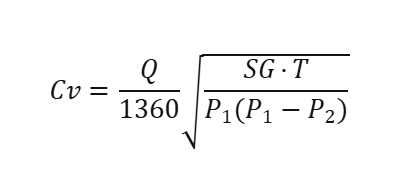
Step 3: Calculate Cv
For subcritical flow (P₂ > 0.5 P₁):
Example:
Q = 150 slpm, SG = 0.97 (N₂), T = 520 °R, P₁ = 500 psig, P₂ = 50 psig
→ Cv = 0.08Step 4: Droop & Decay
- Target droop: < 0.2 psig / 100 slpm
- Supply pressure effect: < 0.02 % / 100 psig
Step 5: Environment
- Temperature: –20 to 60 °C
- Hazardous area: Class I Div 2
- Vibration: 5 g @ 10–500 Hz
Step 6: Compliance
- SEMI F1 (materials)
- ASME BPE (sanitary)
- EN 10204 3.1 MTRs
Step 7: Lifecycle Cost
Factor | Cost Impact |
|---|---|
Initial price | $1,800 |
MTBF 10 yrs | –$1,200 maintenance |
Yield gain | +$15,000 / tool / year |
Installation, Startup, Maintenance
Pre-Installation
- Helium leak test at factory (< 10⁻⁹ atm-cc/sec)
- N₂ purge cylinder 15 volumes
- Cleanroom assembly (ISO Class 5)
Mounting
- Vertical, outlet down
- Independent bracket (no pipe stress)
- 1/4″ EP tubing, orbital welded
Startup Sequence
- Close all valves
- Open cylinder 1/4 turn per second
- Set regulator 10 % high
- Open downstream slowly
- Adjust to exact setpoint
- In-situ He leak check
Maintenance Schedule
Interval | Task |
|---|---|
3 months | External leak check |
12 months | Diaphragm visual |
5 years | Full rebuild |
After upset | Immediate RGA test |
Standards and Certifications
Standard | Requirement |
|---|---|
SEMI F1 | Material compatibility |
SEMI S2 | Toxic gas safety |
CGA E-4 | Performance testing |
ASME BPE | Biopharma surfaces |
ASTM F1397 | Electropolish spec |
ISO 7291 | Gas compatibility |
Future Innovations (2025–2030)
- Smart Regulators
- MEMS pressure sensor
- Bluetooth diagnostics
- AI predicts diaphragm failure 30 days early
- Additive Manufacturing
- 3D-printed Hastelloy flow paths
- < 0.3 cc internal volume
- Advanced Coatings
- ALD Al₂O₃: 100 % moisture barrier
- DLC seats: 75 HRC, zero wear
- Green Gas Compatibility
- F₂/He for NF₃ replacement
- H₂ at 7.0 purity (< 1 ppt S)
- Modular Design
- Field-replaceable cartridge in < 5 minutes
Conclusion
The Unsung Guardian of Process IntegrityA high purity gas pressure regulator is far more than a pressure reducer. It is a micro-contamination firewall, a precision stability engine, and a safety sentinel rolled into a palm-sized package.From the electropolished 316L VIM-VAR body to the tied Hastelloy diaphragm, every feature exists to answer one question:
“Will this molecule reach the process unchanged?”In semiconductor fabs, analytical labs, biopharma suites, and spacecraft—where purity is non-negotiable—the high purity regulator stands as the final, invisible line of defense.Understanding its materials, designs, and protocols empowers engineers to select, install, and maintain these devices with confidence. The result? Higher yields, safer operations, and processes that push the boundaries of science and manufacturing.