
A comprehensive guide to check valve

Table of Contents
ToggleWhat is a Check Valve?
A check valve is a mechanical device designed to allow fluid (liquid, gas, or vapor) to flow in one direction while preventing reverse flow. Its primary function is to protect systems from the damaging effects of backflow, such as pump failure, pipeline contamination, or pressure surges. Check valves operate automatically, using the pressure differential of the fluid to open or close the valve, making them highly reliable in dynamic systems.
The basic components of a check valve include the body, disc (or closure element), seat, and, in some designs, a spring or hinge. The body houses the internal components and connects to the pipeline. The disc moves to allow forward flow or block reverse flow, while the seat ensures a tight seal when the valve is closed. In spring-loaded check valves, a spring assists in closing the valve quickly to prevent backflow.
Check valves work on a simple principle: when the upstream pressure exceeds the downstream pressure, the disc opens, allowing fluid to pass. If the downstream pressure becomes higher (indicating potential backflow), the disc closes against the seat, stopping the flow. This mechanism makes check valves ideal for applications where unidirectional flow is critical, such as in water supply lines or chemical processing plants.
Types of Check Valves
Check valves come in various designs, each tailored to specific applications based on fluid type, pressure, flow rate, and system requirements. Below, we explore the major types with detailed examples to illustrate their use.
1. Swing Check Valves:Description: These valves feature a hinged disc that swings open with forward flow and closes to prevent backflow. They are simple, cost-effective, and have low pressure drop, making them ideal for low-velocity flows.
Example: Wastewater Treatment Plant: In a wastewater treatment facility in Houston, Texas, swing check valves are used in the effluent discharge line. In 2020, the plant installed 12-inch bronze swing check valves to handle treated wastewater flowing to a nearby river. The valves’ large disc design allowed high flow rates with minimal resistance, critical for the plant’s high-volume discharge. However, during heavy rain, the valves’ slow closure led to minor water hammer issues, prompting engineers to add dampening mechanisms. This case highlights the suitability of swing check valves for low-pressure, high-flow applications but also their limitations in rapid flow reversal scenarios.
2. Ball Check Valves:Description: These use a spherical ball as the closure element, which lifts off the seat during forward flow and reseats to block backflow. They are compact and effective for viscous fluids.
Example: Chemical Processing: A chemical plant in Germany producing sulfuric acid uses ball check valves in its transfer lines. In 2022, the plant installed PVC ball check valves to handle the corrosive acid at low pressures. The valves’ simple design minimized maintenance, and their ability to seal tightly prevented acid backflow, protecting upstream pumps. The plant reported a 15% reduction in pump maintenance costs after installation, demonstrating the valve’s effectiveness in corrosive environments.
3. Lift Check Valves:Description: The disc lifts vertically to allow flow and drops back to seal against backflow. These are suited for high-pressure systems but require sufficient upstream pressure to open.
Example: Steam Power Plant: A coal-fired power plant in India uses lift check valves in its high-pressure steam lines. In 2021, the plant retrofitted its boiler feedwater system with stainless steel lift check valves rated for 300 psi. These valves ensured unidirectional steam flow, preventing reverse flow that could damage the boiler. During a system test, the valves maintained a tight seal under fluctuating pressures, proving their reliability in high-temperature, high-pressure conditions.
4. Diaphragm Check Valves:Description: These use a flexible diaphragm that flexes to allow flow and reseals to prevent backflow. They are ideal for low-pressure, corrosive, or sensitive fluids.
Example: Pharmaceutical Manufacturing: A pharmaceutical facility in Switzerland producing vaccines uses diaphragm check valves in its sterile fluid transfer lines. In 2023, the plant installed PTFE-lined diaphragm check valves to handle saline solutions. The valves’ non-reactive materials ensured no contamination, critical for vaccine purity. Their low-pressure operation suited the delicate fluid dynamics, and the plant reported zero contamination incidents post-installation.
5. Dual-Plate Check Valves:Description: Featuring two semicircular plates that pivot to open, these valves are compact, reduce water hammer, and are ideal for high-pressure systems.
Example: Offshore Oil Platform: An offshore oil platform in the North Sea uses dual-plate check valves in its crude oil export pipeline. In 2022, the platform installed 8-inch stainless steel dual-plate valves to handle high-pressure crude oil flows. Their fast closure minimized water hammer during pump shutdowns, extending pipeline life. The compact design also saved space, critical in the confined platform environment.
Each type’s unique features make it suited to specific applications, with selection driven by factors like fluid viscosity, pressure, and system constraints.
Applications of Check Valves
In residential plumbing, check valves are found in sump pumps and water heaters, preventing water from flowing back into basements or supply lines. A notable case study involves the use of dual-plate check valves in a municipal water treatment plant, where they reduced maintenance costs by minimizing water hammer.
1. Oil and Gas Industry
The oil and gas industry relies heavily on check valves to maintain safe and efficient fluid flow in exploration, production, and transportation. These valves prevent backflow in pipelines, protect pumps and compressors, and ensure operational continuity in high-pressure environments.
Case Study: Trans-Alaska Pipeline System
The Trans-Alaska Pipeline System (TAPS), an 800-mile pipeline transporting crude oil from Prudhoe Bay to Valdez, uses dual-plate check valves to manage high-pressure flows. In 2020, a section of the pipeline was upgraded with 24-inch carbon steel dual-plate check valves rated for 1,200 psi. These valves were selected for their compact design and ability to minimize water hammer—a pressure surge caused by sudden flow reversal.
During a pump station failure in 2021, the valves closed rapidly, preventing reverse flow that could have damaged pumps and caused an oil spill. The valves’ corrosion-resistant coating ensured durability in the harsh Arctic environment, reducing maintenance costs by 12% over two years. This case underscores the importance of check valves in protecting critical infrastructure and preventing environmental disasters.
Technical Insight:
In offshore platforms, swing check valves are often used in low-pressure crude oil lines due to their low pressure drop. However, for high-pressure gas lines, lift check valves are preferred for their robust sealing under extreme conditions. Material selection, such as stainless steel or titanium, is critical to withstand corrosive hydrocarbons.
Additional Example: North Sea Offshore Platform
An offshore platform in the North Sea installed 8-inch stainless steel dual-plate check valves in 2022 to handle crude oil export. The valves’ fast closure reduced water hammer during pump shutdowns, extending pipeline life by an estimated 5 years. Their compact design saved space in the confined platform environment, demonstrating the importance of valve selection in space-constrained applications.
2. Water and Wastewater Management
Check valves are vital in water and wastewater systems, preventing contamination and ensuring compliance with stringent regulations. They stop backflow of treated or untreated water, protecting clean water supplies and treatment infrastructure.
Case Study: Los Angeles Water Recycling Plant
The Los Angeles Department of Water and Power (LADWP) operates a wastewater recycling plant that supplies reclaimed water for irrigation and industrial use. In 2021, the plant installed 16-inch ductile iron swing check valves in its effluent discharge lines. These valves prevented backflow of treated water into the primary treatment system, ensuring compliance with California’s Title 22 water quality standards.
During a 2022 power outage, the valves closed automatically, preventing contamination of the clean water supply. This reliability avoided a potential $500,000 fine and protected public health. The valves’ low maintenance requirements also reduced operational costs by 8%, highlighting their cost-effectiveness in large-scale water systems.
Technical Insight:
In water systems, swing check valves are favored for their simplicity and ability to handle high flow rates. However, in systems prone to water hammer, dual-plate or spring-loaded check valves are preferred for faster closure. Materials like PVC or ductile iron are chosen for corrosion resistance in wastewater environments.
Additional Example: Singapore NEWater Facility
Singapore’s NEWater program, which recycles wastewater into potable water, uses diaphragm check valves in its reverse osmosis systems. In 2023, the facility installed PTFE-lined diaphragm valves to handle purified water at low pressures. These valves ensured no backflow of contaminants, maintaining the ultra-pure water quality required for drinking water standards.
3. HVAC Systems
In heating, ventilation, and air conditioning (HVAC) systems, check valves maintain proper fluid flow, ensuring energy efficiency and system longevity. They are used in refrigerant lines, chilled water systems, and hot water loops.
Case Study: Dubai Skyscraper Cooling System
A high-rise in Dubai’s Burj Khalifa district retrofitted its HVAC cooling system with bronze ball check valves in 2023. The 2-inch valves were installed in chiller lines to manage refrigerant flow, preventing backflow that could reduce cooling efficiency. Their compact design fit the tight mechanical rooms, and their low maintenance reduced operational costs by 10%.
During a summer heatwave, the valves maintained consistent refrigerant flow, ensuring occupant comfort in the 50-story building. This case highlights the role of check valves in energy-intensive environments.
Technical Insight:
Ball check valves are ideal for HVAC systems due to their low pressure drop and suitability for viscous refrigerants. Spring-loaded check valves are sometimes used in high-pressure systems to ensure rapid closure.
Additional Example: New York Office Building
A Manhattan office building installed lift check valves in its hot water heating system in 2022. The stainless steel valves, rated for 200 psi, prevented backflow in the boiler loop, improving heating efficiency and reducing energy costs by 5% annually.
4. Chemical and Pharmaceutical Industries
Check valves are critical in chemical and pharmaceutical industries, where they handle corrosive or sensitive fluids, ensuring process purity and equipment safety.
Case Study: Indian API Plant
An active pharmaceutical ingredient (API) plant in Hyderabad, India, uses diaphragm check valves for solvent transfer. In 2022, the plant installed PTFE-lined diaphragm valves to handle corrosive solvents like acetone. The valves prevented backflow, ensuring no cross-contamination between batches—a critical requirement for FDA compliance. The plant reported a 20% increase in production efficiency due to reduced downtime from contamination incidents. The valves’ non-reactive materials were key to maintaining product purity.
Technical Insight:
Diaphragm check valves are preferred for their chemical resistance and ability to handle low-pressure flows. In high-pressure chemical lines, lift check valves made of Hastelloy or titanium are used for durability.
Additional Example: German Chemical Plant
A chemical plant in Germany producing sulfuric acid installed PVC ball check valves in 2022. The valves’ simple design minimized maintenance, and their tight sealing prevented acid backflow, protecting pumps and reducing repair costs by 15%.
5. Power Generation
In power generation, check valves protect turbines, boilers, and cooling systems by preventing reverse flow in steam, water, or fuel lines.
Case Study: UK Nuclear Plant
A nuclear power plant in the UK uses titanium lift check valves in its cooling water system. In 2021, the plant installed 10-inch valves to handle seawater at 300 psi. The valves prevented backflow, protecting cooling towers from corrosion and ensuring uninterrupted power generation. During a 2022 maintenance shutdown, the valves’ robust design allowed quick inspection, minimizing downtime. This case highlights the importance of material selection in corrosive environments.
Technical Insight:
Lift check valves are ideal for high-pressure steam or water lines, while swing check valves are used in low-pressure cooling systems. Titanium or stainless steel is chosen for corrosion resistance.
Additional Example: Australian Coal Plant
A coal-fired power plant in Queensland installed dual-plate check valves in its boiler feedwater system in 2023. The valves’ fast closure reduced water hammer, extending pump life by an estimated 3 years.
6. Residential Plumbing
In residential plumbing, check valves prevent backflow in water heaters, sump pumps, and irrigation systems, protecting homes from flooding and contamination.
Case Study: Florida Sump Pump Installation
A residential complex in Miami installed 2-inch PVC ball check valves in its sump pump systems in 2023 to prevent basement flooding during hurricanes. During a Category 3 storm, the valves ensured water was pumped out without backflow, protecting 50 homes from water damage estimated at $200,000. The valves’ low cost and easy installation made them a practical solution for flood-prone areas.
Technical Insight:
Ball and swing check valves are common in residential applications due to their affordability and reliability. PVC is often used for its corrosion resistance and ease of installation.
Additional Example: California Water Heater
A suburban home in Sacramento installed a brass swing check valve in its water heater system in 2022. The valve prevented hot water backflow, protecting the cold-water supply and extending the heater’s lifespan.
How Does a Check Valve Work?
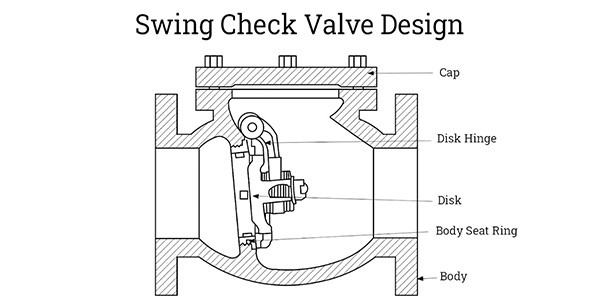
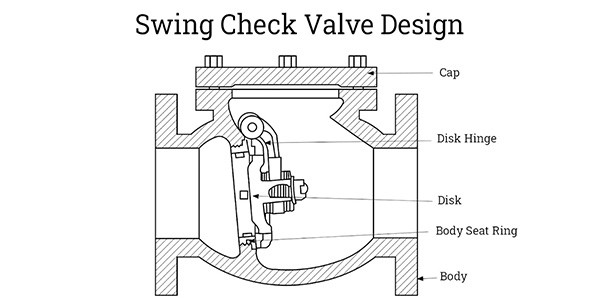
To understand how a check valve functions, it’s crucial to first examine its construction. A basic check valve consists of four key components: the body, seat, disc, and cover, as illustrated in the diagram below.
Depending on the design and function of the check valve, additional components such as springs, balls, stems, and hinge pins may be incorporated into the basic elements.
Swing
Swing check valves feature an unguided disc that swings open fully when flow pressure is applied. They are available in various sizes and designs to suit different applications.
Lift
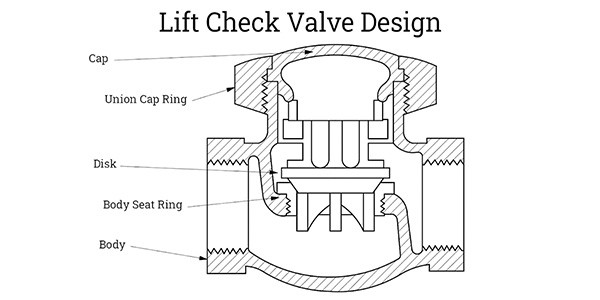
Lift check valves use a guided piston that rises when flow enters the valve. The seat has a barrel design and is secured with screws and seals. The valve’s opening matches the size of both the inlet and outlet.
Tilting
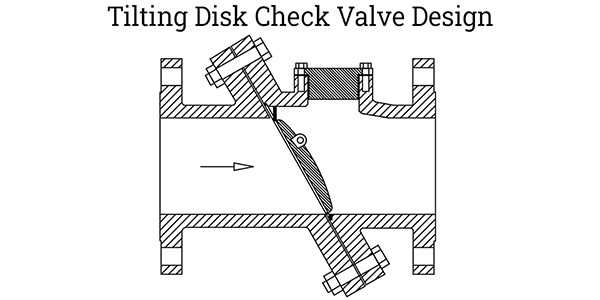
Tilting check valves are designed to address some issues associated with swing check valves, which have been the most common type. They can stay open at low flow velocities and close swiftly when the flow stops. They are particularly effective in high-velocity applications.
Folding Disk
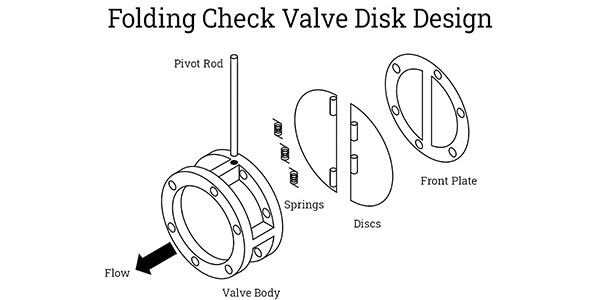
The folding disc check valve features a split disc design and a wafer body pattern with a soft seat. The discs are held in place by a pivot rod and open in response to the flow pressure. Springs on the discs assist in closing the valve.

Vertical Check Valves
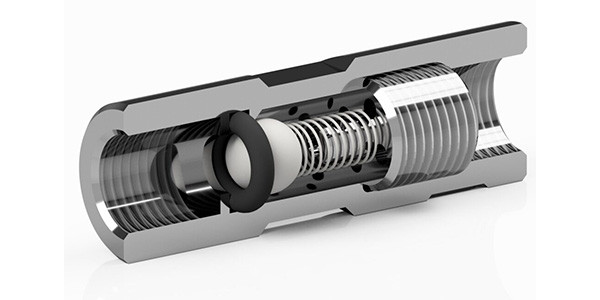
Vertical check valves are also known as spring check valves A spring keeps the disc pressed against the seat in a vertical or spring check valve. The valve remains closed due to the spring until sufficient pressure is applied to compress the spring and open the valve.
Common Problems with Check Valves
Water Hammer
Water hammer is caused by a pressure surge when there is a sudden stop in the flow of a gas or fluid and the valve suddenly closes, which causes noise and vibrations. Water hammer can damage the system and lead to costly repairs
Water hammer can be mitigated by using check valves that close quickly, thereby preventing pressure surges and shock waves. Silent check valves are one effective solution to address this issue.
Reverse Flow
Reverse flow can be damaging and costly, as it may cause a pump to spin in the wrong direction. This issue can be addressed with tightly fitting, fast-closing check valves. Spring-assisted check valves, in particular, are beneficial because they react quickly to prevent reverse flow.
Oversizing
Some check valve systems experience chattering due to frequent opening and closing of the valve, often caused by an oversized valve. Proper sizing is crucial when installing a check valve to ensure it fits the application. The disc must remain stable when open and create a complete seal when closed to prevent issues like fluttering, repeated cycling, and potential valve failure.
Installation
Improper installation and assembly of a check valve can lead to future issues. The initial step is to select the appropriate check valve for the application, considering factors such as flow capacity, positioning, and orientation. Installing a check valve too close to a pump, for example, can result in turbulence and potential damage to the valve.
Check valves should be installed at least several straight pipe diameters upstream from circulators, elbows, tees, and strainers to avoid turbulence and prevent the disc from rattling against the seat.
Materials Used to Make Check Valves:
Check valves are typically constructed from durable materials to endure high-pressure conditions. Common materials used in their manufacture include PVC, CPVC, bronze, brass, iron, and stainless steel.
Polyvinyl Chloride (PVC): PVC is corrosion resistant and flexible. The smooth surface of PVC allows the check valve parts to move easily.
Chlorinated Polyvinyl Chloride (CPVC): CPVC has the same qualities as PVC but is able to endure high temperature applications.
Bronze: Bronze can be used for low and medium pressure applications, be cast in complex configurations, and is corrosion resistant.
Brass: Brass has the same abilities as bronze as well as the same machinability and is less expensive than bronze.
Cast Iron:Cast iron check valves are used for hot and cold water, HVAC, steam, gas, and utility services due to its excellent corrosion resistance.
Ductile Iron:Ductile iron has more than 3% carbon so it can be bent and shaped easily. It is stronger than cast iron and is easier to form into check valves.
Iron: Iron is used for steam, water, oil, and gas applications. It can endure a wide range of temperatures and pressures. Its excellent performance balances its high cost.
Stainless Steel: Stainless steel is corrosion resistant, durable, and can be used in harsh conditions, including chemical applications.
Polypropylene (PP):PP is used to make check valves due to its exceptional resistance to corrosion, which is superior to CPVC and PVC.
Polyvinylidene Difluoride (PVDF):PVDF plastic is used in applications where exceptional purity and resistance to acids, solvents, and hydrocarbons are a necessity.
Cast Steel:Cast steel is used to produce check valves due to its sudden impact resistance without deforming, breaking, or bending. It can also be easily shaped to any type of check valve.
Conclusion
Check valves are indispensable across diverse industries, from oil and gas to residential plumbing. Their ability to prevent backflow ensures safety, efficiency, and compliance in critical systems. Case studies, like the Trans-Alaska Pipeline’s use of dual-plate valves or the Los Angeles water plant’s swing check valves, demonstrate their real-world impact. By selecting the appropriate valve type—swing, ball, lift, or diaphragm—and materials like stainless steel or PVC, engineers can tailor solutions to specific challenges, whether it’s handling corrosive chemicals or protecting municipal water supplies.As industries evolve, check valves will continue to play a vital role, with innovations like smart valves enhancing their functionality. Understanding their applications equips professionals to design and maintain robust systems, ensuring operational success and environmental safety.